There is a quiet moment many mothers experience.
It doesn’t arrive dramatically.
It doesn’t announce itself.
It slips in somewhere between routine and responsibility —
when you catch your reflection and think:
I feel different.
Not worse.
Not broken.
Just… different.
This essay is part of the Identity in Motherhood series, where we explore identity shifts, matrescence, grief, and the process of integrating who you are becoming.

And in that difference, a question begins to surface:
Who am I now?
Motherhood does not erase you.
But it does reorganize you.
And that reorganization can feel unsettling.
Because redefining yourself in motherhood is rarely something we are taught how to do. We are prepared for birth. We are prepared for baby care. But we are rarely prepared for the internal shift — the identity after baby that asks us to expand without disappearing.
For many women this shift begins after pregnancy and birth. For others — including mothers through adoption, surrogacy, fostering, or step-parenting — it emerges as identity reorganizes around caregiving, attachment, and responsibility.
So what does that actually look like?
What Does Redefining Yourself in Motherhood Actually Mean?
Redefining yourself in motherhood means allowing your identity to evolve without abandoning your core self.
It is not:
- returning to your pre-baby identity unchanged
- dissolving into “just mom”
It is integration.
You are not choosing between:
- who you were
- and who motherhood requires you to be
You are learning to hold both.
This process often begins with the early disorientation explored in Identity Shifts After Becoming a Mother, when the familiar sense of self begins to loosen and expand.
Why You May Feel Like You’re Losing Yourself in Motherhood
The feeling of losing yourself in motherhood is common — especially in the early years.
Here’s why:
- Your time is no longer fully your own
- Your body may feel unfamiliar
- Your nervous system stays on constant alert
- Your ambitions may feel paused or redirected
- The mental load of motherhood grows
- Previous routines disappear
When your energy is devoted to everyone else’s needs, it can feel like nothing is left for you.
But identity expansion often feels like identity loss in the beginning.
Growth rarely feels graceful in the middle of it.
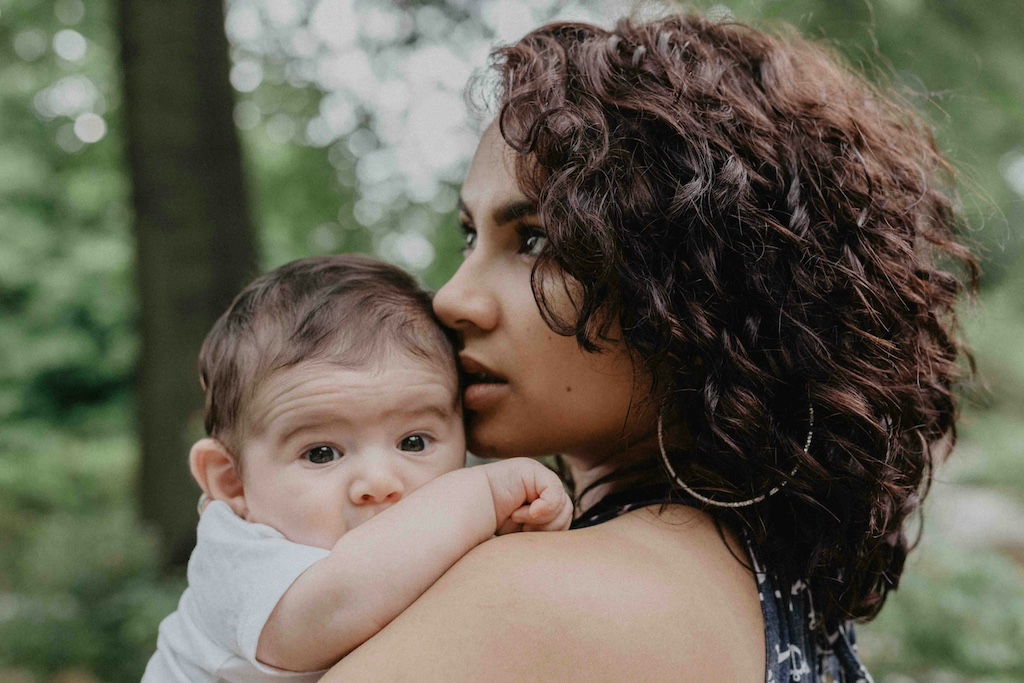
Losing Yourself vs. Evolving: What’s the Difference?
Losing yourself implies disappearance.
Evolving implies transformation.
Motherhood can expand:
- Emotional depth
- Resilience
- Clarity about what matters
- Boundaries
- Compassion
- Capacity
The tension arises when you try to preserve your former identity exactly as it was.
But identity is not meant to remain static.
As explored in Grieving Your Pre-Motherhood Identity, grief and growth often coexist. You can mourn who you were while still welcoming who you are becoming.
That is not regression.
It is integration.
How to Reclaim Your Identity After Baby
If you feel disconnected from yourself, there are gentle ways to begin reclaiming your identity while allowing space for change.
1. Identify what still feels true
What values, interests, or traits still feel like you?
Protect small expressions of them.
2. Create micro-spaces of autonomy
You do not need hours.
You need intentional ownership of even small windows of time.
3. Share the mental load
Chronic cognitive overload accelerates identity erosion.
When caregiving responsibilities are shared, identity has room to breathe again.
4. Reassess what “productive” means
Motherhood often reshapes ambition.
That does not mean you have become less driven — only more discerning.
5. Allow identity to remain fluid
You do not need a fixed answer to Who am I now?
You are allowed to be in process.

Redefining Yourself in Motherhood Without Guilt
One of the biggest barriers to redefining yourself is guilt.
Guilt for:
- wanting time alone
- wanting creative work
- wanting ambition
- wanting rest
- wanting space beyond motherhood
But self-expansion does not threaten your children.
It models wholeness.
When your children see you honoring your body, protecting your rest, and growing as a person, they learn that adulthood is dynamic — not depleted.
You are teaching them what it looks like to evolve.
You Are Not Disappearing — You Are Becoming
Motherhood reorganizes you.
Your time.
Your body.
Your priorities.
Your inner landscape.
And in that reorganization, it can feel like something familiar has gone quiet.
But different does not mean diminished.
It means expanded.
The question is no longer:
Who am I now?
It becomes:
Who am I becoming?
Redefining yourself in motherhood is not about recovering who you were.
It is about integrating who you have been with who you are growing into.
You are not disappearing.
You are becoming — forward.
Continue the Identity Series
This reflection is part of the Identity in Motherhood series, exploring the evolving relationship between identity and motherhood.
You may want to continue with:
Next: Integrating Your Evolving Identity in Motherhood
Or explore the full guide to Identity in Motherhood.
Leave a Reply