

It often starts with something small.
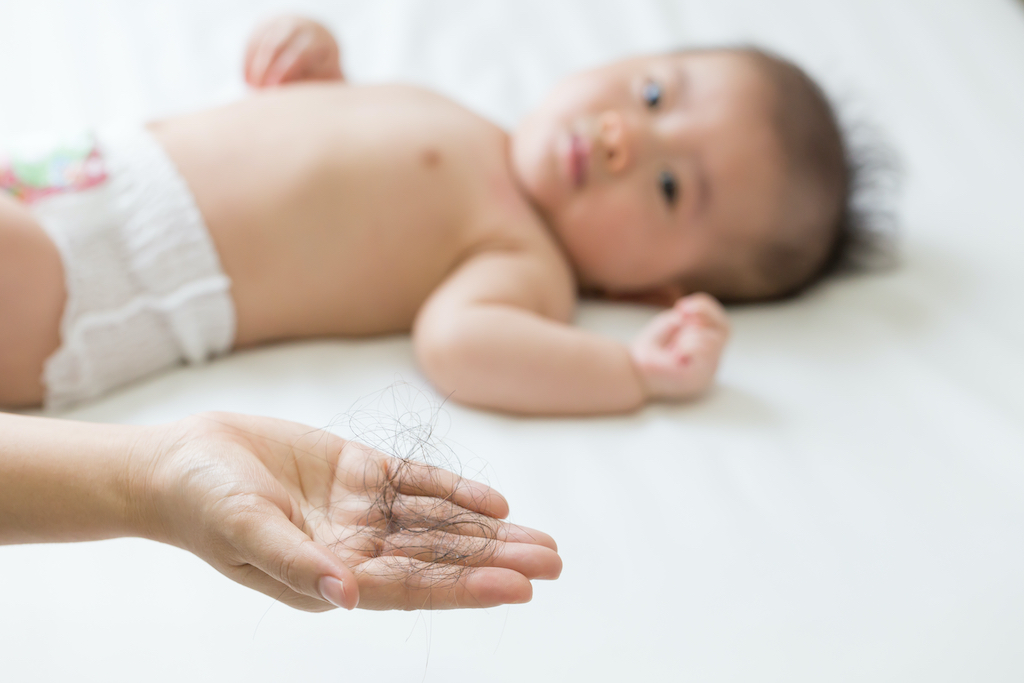
More hair than usual in your brush.
In the shower.
On your hands.
It often begins a few months after birth. Hair that once felt full may start shedding more noticeably, sometimes in ways that feel sudden or difficult to ignore.
It can be surprising.
Especially when it appears just as you are beginning to adjust to life with a new baby.
But this experience is not random.
It is part of how the body transitions after pregnancy. It’s something you see and feel at the same time.

Why Postpartum Hair Loss Happens
Postpartum hair loss often begins quietly, as the body moves through its own internal recalibration.
One of those changes affects the natural hair growth cycle.
Hair typically moves through phases of growth, rest, and shedding. During pregnancy, higher estrogen levels can extend the growth phase, which means less hair sheds than usual.
After birth, those hormone levels begin to shift again.
Hair that remained in the growth phase during pregnancy starts to move into the shedding phase.
This is why postpartum hair loss often feels like it happens all at once.
In reality, it is the body returning to its natural rhythm. In reality, it is part of the experience of motherhood.
When Postpartum Hair Loss Starts
For many mothers, postpartum hair loss begins around:
2 to 4 months after birth, though timing can vary.
For some, it may begin earlier. For others, later.
This variation is normal. The body does not follow a single timeline, especially during postpartum recovery.
How Long It Lasts
Postpartum hair loss is typically temporary.
For many, shedding slows within the first year after birth as hormone levels stabilize and the hair growth cycle regulates.
Regrowth often begins gradually.
You may notice:
shorter hairs along the hairline
new growth around the temples
a shift in overall texture
This process can take time.
Not because something is wrong, but because the body is recalibrating.
The Role of the Body in Recovery
Hair changes are one small part of a larger transition.
After birth, the body is adjusting across multiple systems:
hormonal
nutritional
physical
emotional
These systems are connected.
What the body is experiencing overall can influence how changes, like hair loss, appear.
This is part of the broader postpartum experience explored in Postpartum: A Season of Recovery, Identity, and Becoming, where recovery is understood as a whole-body process.
Supporting the Body During This Time
There is no way to immediately stop postpartum hair loss.
But the body can be supported as it moves through this phase.
Support often looks like:
consistent nourishment
hydration
rest where possible
gentle care of the scalp and hair
This is not about correcting the process.
It is about supporting the body as it regulates.
This approach aligns with what we explore in Healing During Motherhood: A Gentle Guide to Body & Nourishment, where care is sustained rather than reactive.
When It Feels Concerning
In most cases, postpartum hair loss is a normal part of recovery.
However, if shedding feels prolonged or severe beyond the first year, it may be worth exploring additional support.
This is not about assuming something is wrong.
It is about staying responsive to the body.
A Broader Perspective
Postpartum hair loss is often discussed in isolation.
But it is one expression of a much larger transition.
The body is shifting.
Rebalancing.
Adjusting to a new baseline.
Seen this way, hair loss is not an isolated issue.
It is part of a system returning to equilibrium.
Closing
Postpartum hair loss may feel noticeable.
At times, even unsettling.
But it is a sign that the body is moving through a process of adjustment.
Not instantly.
Not all at once.
But gradually.
And in that process, change is happening.
Even when it feels unfamiliar.